Em, Iran. Upstate NY.
Em, an Iranian national, was detained upon his arrival in the United States in September 2024 after fleeing persecution in his homeland. As an Information Technology specialist who worked for the Iranian police, Em found himself in the crossroads of the 2022-2023 protests that erupted following the death of a woman who was killed in police custody. She was killed in the prison for not wearing hijab.
Em was assigned to crowd control during these demonstrations. He received orders to physically harm protesters, but he refused. Due to this refusal, Em was court martialed and faced criminal charges and acts against the government. Em feared for his life, so he made the difficult decision to flee Iran, leaving behind his wife, 11-year-old son, and the rest of his family.
The danger that Em faces extends beyond his refusal to harm innocent people. As Protestant Christians, Em and his family are at greater risk of reprisal and persecution.
Despite seeking asylum in the United States, Em was immediately detained by immigration officers upon arrival. His asylum application was denied, though he is currently appealing this decision, with a ruling expected in March 2026. Should this appeal fail, he would have one final opportunity to appeal before a federal court before facing deportation.
During his 16 months in custody, Em has tried to remain resilient, teaching himself how to speak English. He holds onto hope that he will be granted asylum, allowing him to begin a new life in the United States and eventually being reunited with his family. His only wish is to hug his son again.
Interview collected by Kalieb & Travis 1/19/26. Art by Deb Salzman.
A ______, Pakistan. From Endwell, NY.
A___ came to NY from Punjab, Pakistan in 2021 on a Tourist visa to visit family in New York City when he was 18 years old. He was originally planning on just visiting, but his older brother wanted to stay so he decided to stay too. They moved to Endwell, NY in 2022. His family runs several local businesses, including a local restaurant.
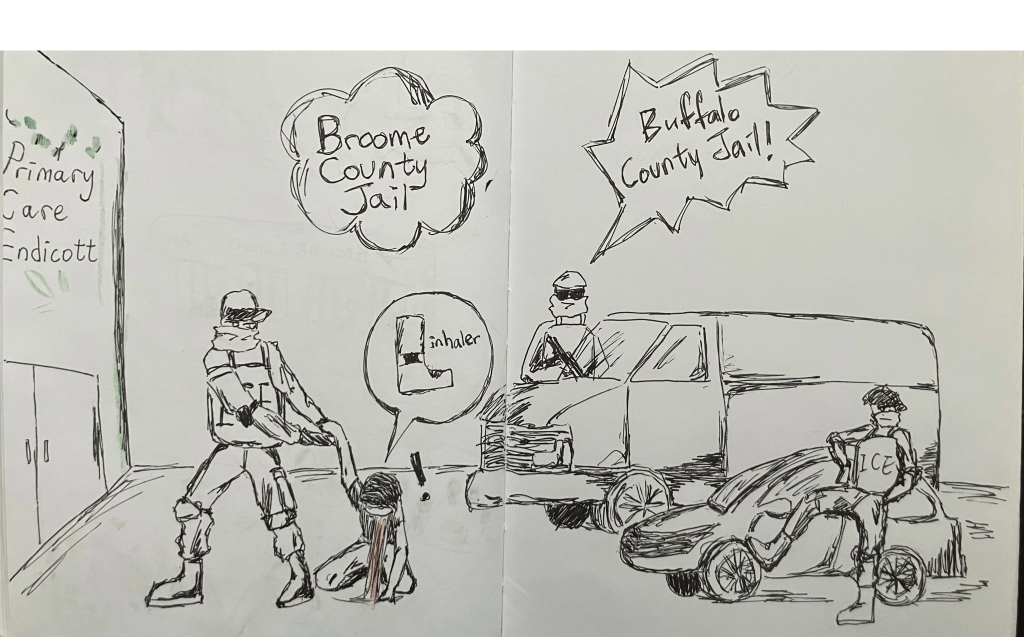
On September 15th, 2025, he was very sick and went to a 1PM doctor’s appointment at UHS Primary Care in Endwell. Undercover officers pulled him over and pulled him from the car. They said that they had officers waiting outside his house to take his family (he later found out that this was a bluff). He was on the phone with a friend when the cops pulled him over. The cops hung up the phone and he could hear his family trying to call him but they would not let him answer the phone.
The officers pulled him from the car and he started vomiting. He said that he needed his inhaler from the car but they wouldn’t give it to him. They called their supervisor and had him waiting in a car for 15-20 minutes on McKinley Avenue. They then drove to his family’s house with a Dodge SUV and 2 more cars from local police, Ford SUVs.
A_’s home is a 2-family house, with his uncles living on the first floor and him and his cousin on the second floor. When they asked him who lived on the first floor, he lied and said “I don’t know. It’s a white family and we don’t really speak to them.” So the cops did not go in there and his uncles were safe. There’s a guest house behind the house. He said, “it’s an old Black lady.” They knocked on her door and asked her to come out for questioning.
The ICE officers called his cousin. They said, “We arrested your cousin and we came to give the car keys to you so you can bring the car back from the doctor’s office.” When the cousin came out for the keys, they arrested him too.
They did not allow him to call any family. They took him in a car to the Holiday Inn parking lot in Binghamton and held him for 2 hours in the parking lot. He said there were a lot of ICE officers and vehicles there. Then, they detained him in a solitary room in Syracuse. They pushed him to sign documents stating he was self-deporting, but he refused to sign because the documents were all wrong- they said he was from Ecuador, when he is from Pakistan. He said he wanted to speak with a lawyer before signing anything. They told him he would be taken to the Buffalo County Jail. They let him have one phone call and he told his family they were taking him to Buffalo.
The next day they took him to the Broome County jail. This was very lucky because his uncles, who are citizens, could visit him. A lot of his family could not visit because they are not citizens. He requested to be put with his cousin but they put him in solitary confinement for 6 days. His cousin got sick in solitary confinement, and was hospitalized for 7 days. No calls to family for 7 days— then he was taken to K-pod. He was told he had a court date for October 2, but there was no call on October 2, so they then gave him a new date. He had 2-3 differnt court dates, then he was released on bail. His family had sold their Halal restaurant to pay for the bail and legal fees. A_ paid $5000 and his family paid $10,000.
He has a lawyer from NYC and has applied for asylum. He currently has an ankle monitor and is on the ADT program. He drives for a delivery service, works at a local gas station and needs to report to Syracuse every 3 weeks. His cousin is out on bail under the same arrangement.
He said he wants the people in the jail to be treated better. He said that when he was there the officers would not let him and his brother pray. He said that the ICE officers are supposed to visit 1x/week, but instead they only visited 3 times during the time he was there.
He is worried because his brother has a court date in NYC in a few weeks and he is afraid ICE will detain him on his way to court.
He said that his cousin was also brought deportation papers while he was inside, but just like him the papers were incorrect so he also didn’t sign. His cousin arrived in 2024, but the ICE officers were saying they had records of him coming in 2022. At one point, they brought deportation papers to his cousin saying “You signed it.” But he had never signed anything. He feels they may be confusing him with somebody else with the same name.
He talked about some of the folks we already met, whose narratives you have already read on this website, humansofice.org. He said there were many Chinese people in K-pod for 3 months, then they were all gone. We talked about Guan Heng’s case, and he said he didn’t think he would win asylum. He said that he only saw one person whose case was approved, and it was a guy from Belarus. Now that he hears that Guan Heng is free, he wants to shake his hand.
Interview collected by Christina Zawerucha on 1/24/26. Illustration by local artist Blue Magnolia.
F, China. From Upstate NY.
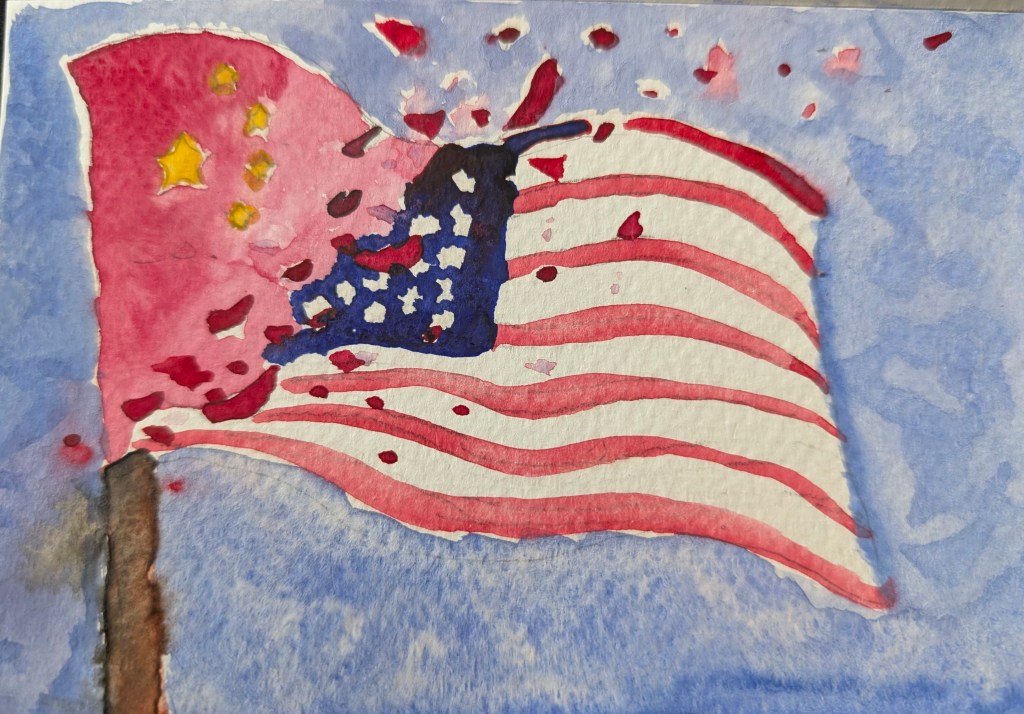
F escaped China from political prosecution. F flew to Central America and sailed to the US to seek asylum.
F filed for asylum and received a work permit. F lived a quiet and lawful life in upstate NY until ICE showed up to pick up someone else and F happened at the scene. Even though ICE had no warrant for F, and he had legal documents, they decided to detain F anyway.
In BC jail, most immigrants were housed in a dorm rather than in a regular pod. Everyone slept in bunk beds placed close together, so at night it was hard to avoid noise, people talking and snoring often kept him from falling asleep. F said, “I had to make my own earplugs using toilet paper and plastic food wrap to reduce the noise.” (This was a trick an American inmate named Nicolas taught me. He was a big, tall man who had stayed in the dorm with us immigrants for a while before being transferred to a prison in upstate.)
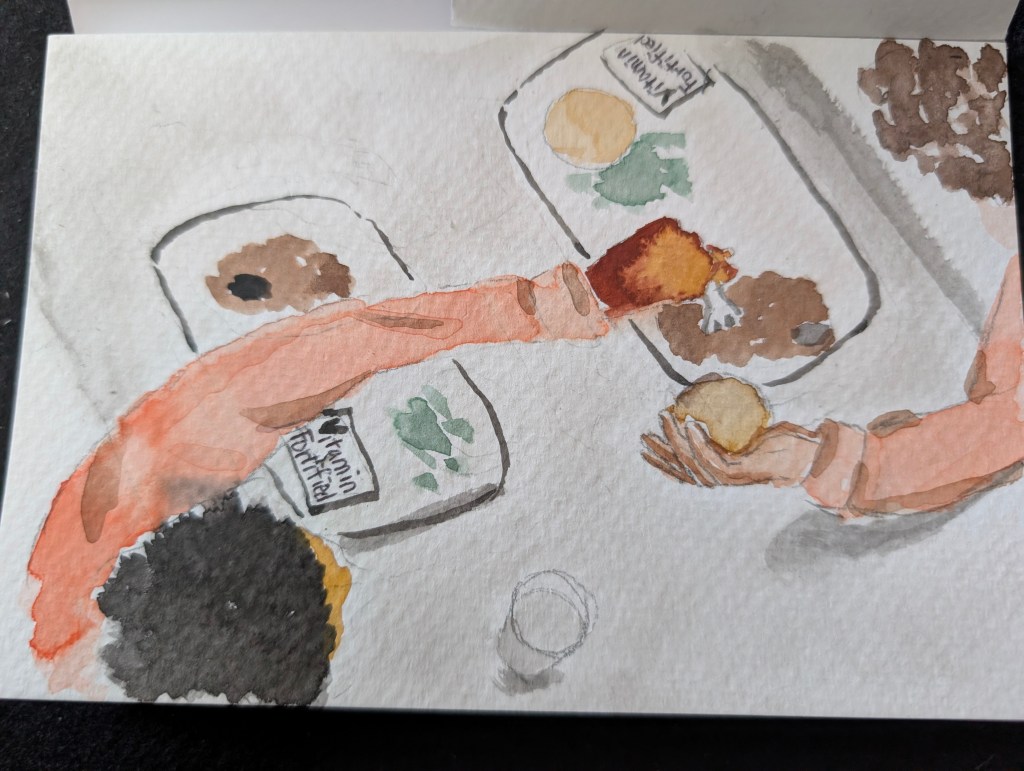
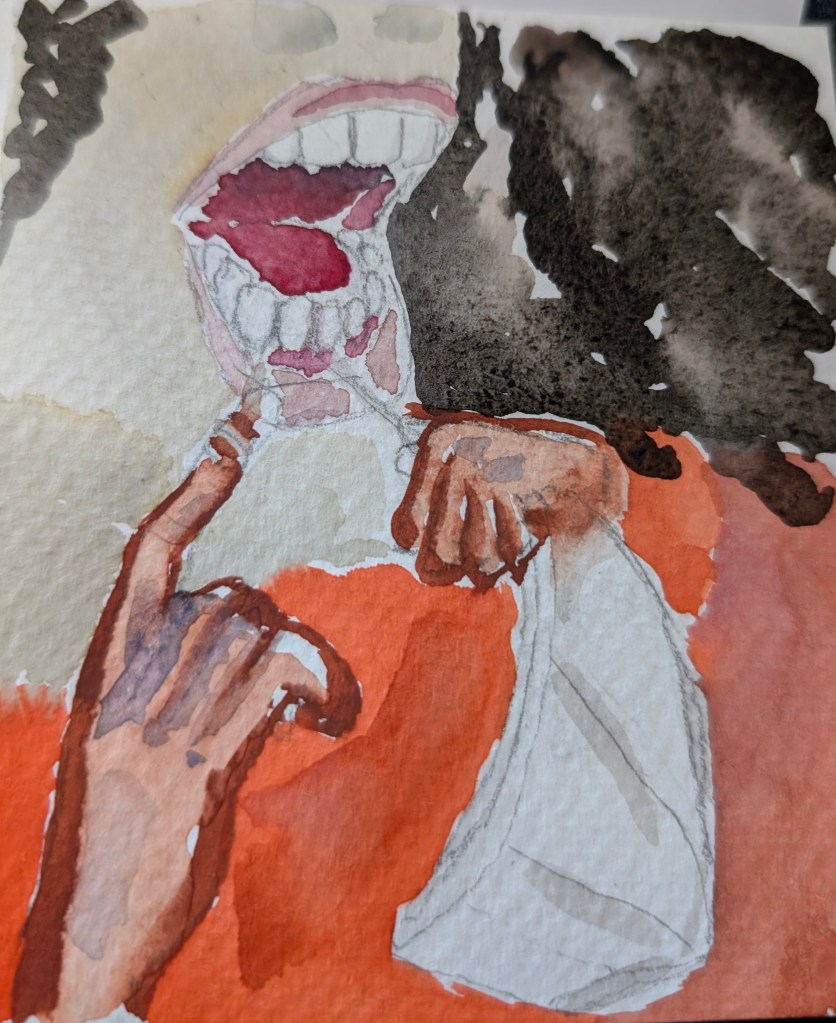
There was no dental floss in jail. F pulled threads from his underwear to floss his teeth.The prison meals couldn’t accommodate diverse diet restrictions. F and fellow prisoners would exchange food items to follow or help follow their dietary practices.
When the weather wasn’t too cold, F liked sitting in the yard to soak up the sun. There were many Central American hispanic immigrants, most of whom were Catholic. Sometimes after dinner, they would gather in a corner of the yard to sing and recite prayers. F enjoyed sitting on the other side, quietly listening. As the sun set, they would come over to shake his hand, hug him, and offer blessings. From this, F felt a sense of calm.
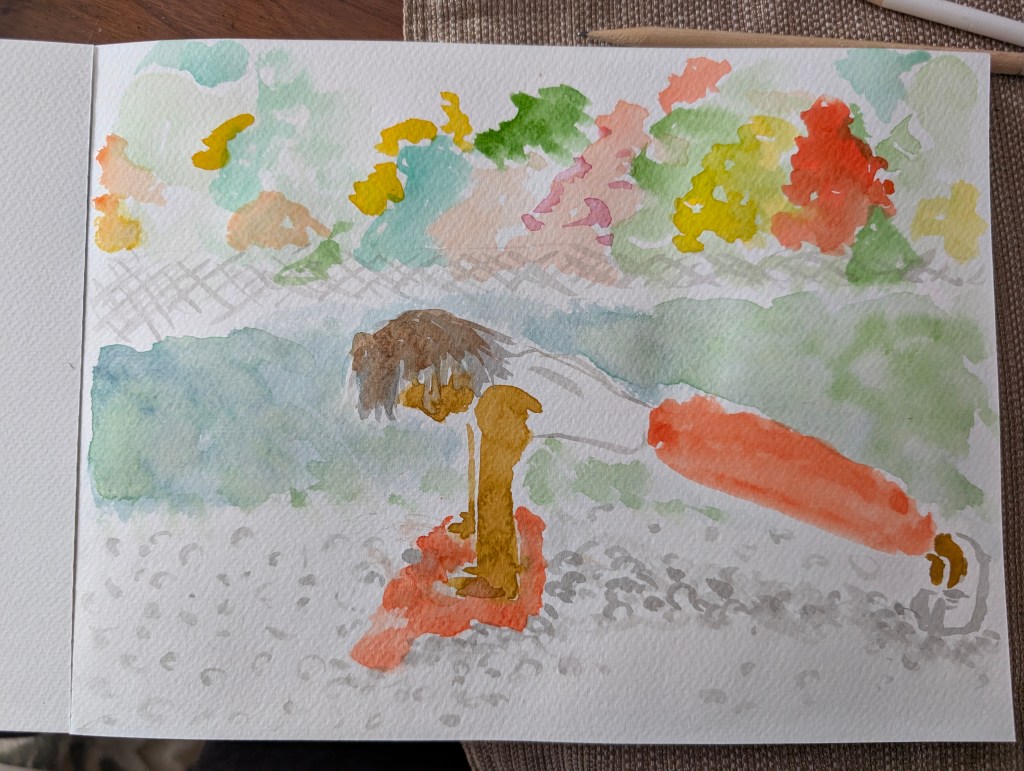
F felt devastated at the beginning and almost agreed to self deport. With encouragement and support from his family and the local community, F continued to seek asylum. Eventually, his asylum was granted. Now F is breathing the free air again.
Narrative and art created by Ü Lee, 2/12/26.
F___, Ghana. From Michigan, USA.
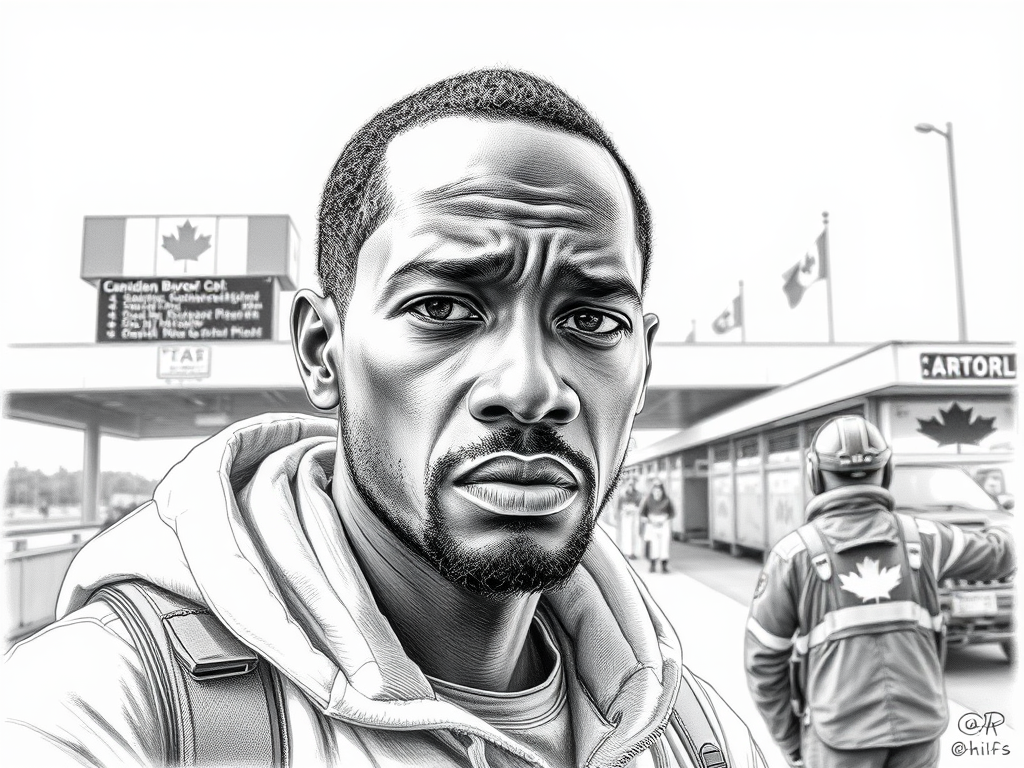
F________, a Ghanaian national, was detained by immigration authorities in December 2025 after attempting to leave the US and cross the border into Canada. He had been living in Michigan with his brother and two sisters, all three of whom are American citizens. F fled Ghana and entered the United States in 2021 to seek asylum after he and his partner were attacked by authorities in his home village.
F_____ is a bisexual man, an identity that is criminalized in his culture. During the attack, F was seriously wounded but managed to escape. His partner, however, sustained fatal injuries and later died. Following his arrival in the United States, F applied for asylum, but his request was denied. This denial is what led him to attempt to seek asylum in Canada.
For four years, F_______ lived and worked in the United States. He was employed as a security officer at a local airport and later worked as a delivery driver for FedEx. Prior to his detention in December, F had never been arrested, received a traffic citation, or faced any criminal charges in the United States. The only persecution he has ever experienced has been based on his sexual orientation in Ghana.
When he was first detained, F described feeling afraid and overwhelmed. He explained that being held alone in a cell was especially difficult, though his spirits improved after being transferred to a cell block with other ICE detainees. To F____’s surprise, he is currently being held in ICE custody with a man that he knew from Ghana. F and his family are currently appealing the denial of his asylum claim. He asked his siblings not to tell their mother about his detention, fearing it would cause her unnecessary distress. F said that he loves the United States and that his only wish is to remain here with his family.
Collected by Kalieb 1/29/26.
C, Thailand. Upstate NY.
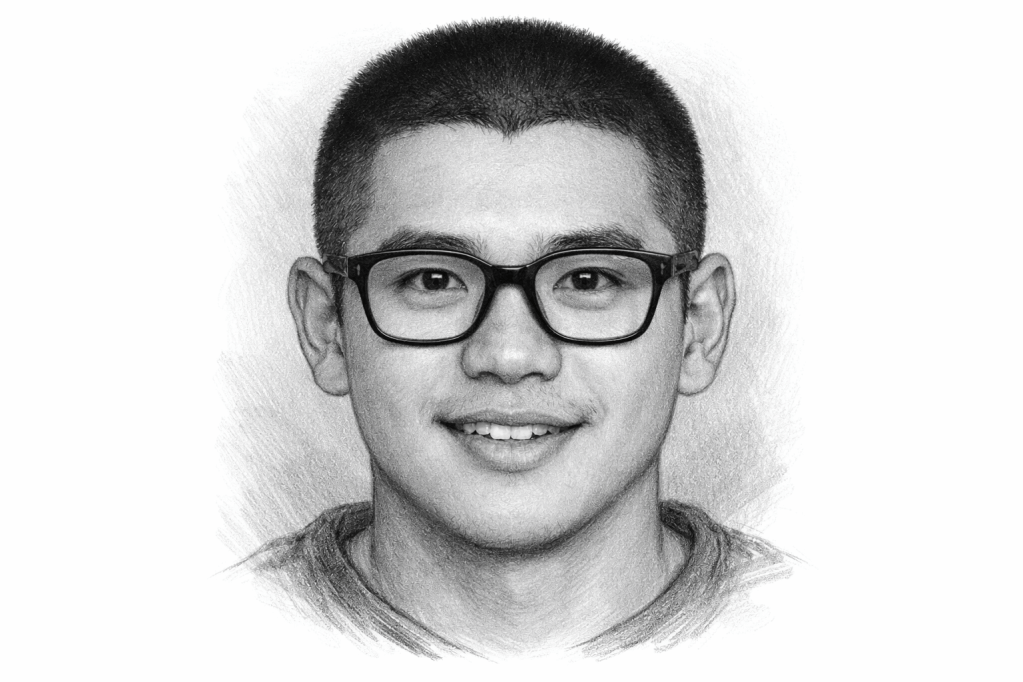
The first thing I noticed about Chuck was his smile. It was slight, but suggested a quiet kindness and keen sense of humor. He didn’t know who we were, but he seemed genuinely happy to see us as we walked into visitation.
It was mid-January and he had been locked up in the Broome County Jail for months, sharing a detention block with strangers and guards while we celebrated Thanksgiving and counted down as the New Year’s ball dropped. Chuck is a young man, who expects to spend his next birthday incarcerated. But that’s ok because Sheriff Akshar will have profited $152 for housing him that day. That’s the per diem he receives from the federal government for every ICE detainee in his jail, which he keeps fully stocked.
Chuck moved to NY when was very young. He went to school in elementary, middle, and high school in Western NY and attended a community college in central NY. He learned enough at the later to realize that he really doesn’t like automotive technology and was weighing his other options. He really likes doing barbering and might pursue that in the future. This was what was going on in his life when he was detained by a group of ICE agents in his neighborhood. They came around the block and kidnapped him, assuming he was one of the Burmese folks they were out looking for. He immediately opted to self deport, deciding that he preferred to go back to Thailand, where he would find his mother. He didn’t realize how long it would take.
ICE kept his personal belongings. When we asked how we could help him, he said that he was very concerned about his phone. He would need it to call his mother when he arrived back in his country of origin. It also had his money on it, barring the $30 he had when he was detained. The jail issued him two used orange jumpsuits, which they wash once per week. He has to manually scrub his own underwear. He had a paltry commissary budget, now spent, which was used for any form of stimulation, including $0.03 per minute of radio, which was preferable to the $0.05 per minute for news. He now passes the time with the other ICE detainees by playing card games or chess but very few of them share a language. Occasionally, an ICE agent will show up to have someone sign paperwork. Whenever they’re asked questions, all they say is that they aren’t their case workers. When we first spoke to him he didn’t even know if he had a case worker.
Collected by Chris Harasta from interview on 1/22/2026
M__, Azerbaijan. From Brooklyn, NY
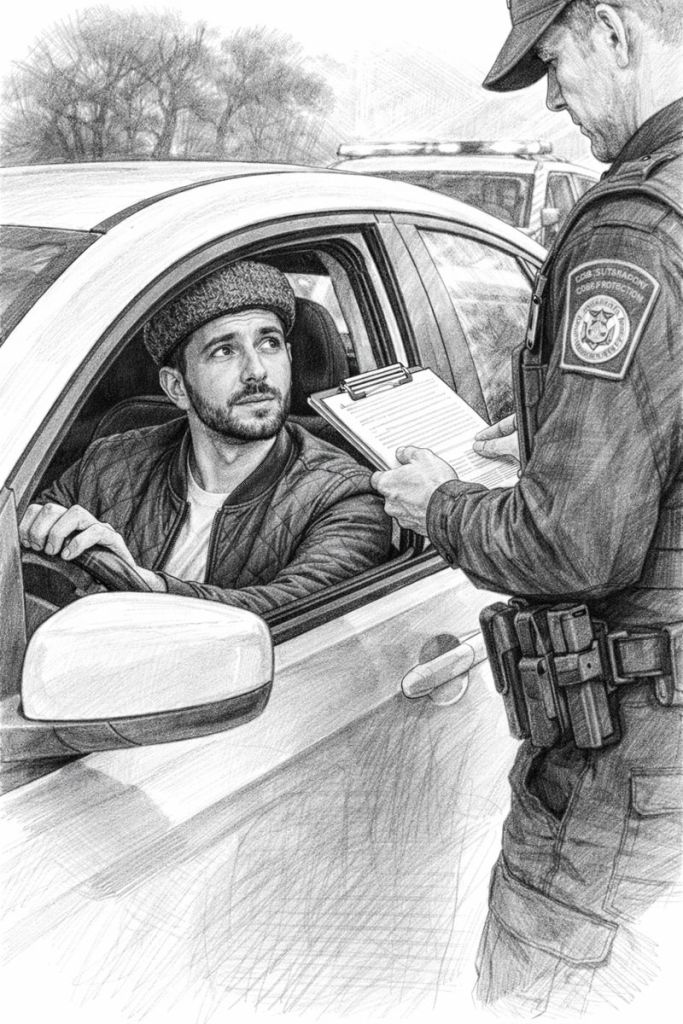
M. was working as a Livery cab driver in Brooklyn when he was detained by ICE. Originally from Azerbaijan, M. came to the US 8 years ago seeking asylum. He did not want to talk about his asylum case because he has decided to self-deport back to Azerbaijan due to lack of legal representation.
He picked up a passenger from a hotel in Brooklyn that asked for a ride all the way up to another hotel close the US-Canadian border. It’s not common, but long cab rides like that do happen. Border Patrol followed him for the last two miles, detained his passenger and him.
M’s main ask was to please get the ICE app that was on the tablets in Batavia installed on the tablets here in BCJ. Right now he can’t get a hold of his deportation officer so he doesn’t know his exact deportation date. He says every time he asks for help from COs here, they say they cannot help him because it’s an ICE matter. He says that there aren’t actually any ICE sergeants working at the BC jail, and that he feels there should be at least one so they can get help with these questions.
M understands that he is leaving soon, and that we probably can’t help him. But he gave us permission to share his story. He said, “Even if you can’t help me, maybe you can help the people who come after me.”
Interview collected by Christina Zawerucha on 12/18/25.
M____, Ghana. From Manchester, CT
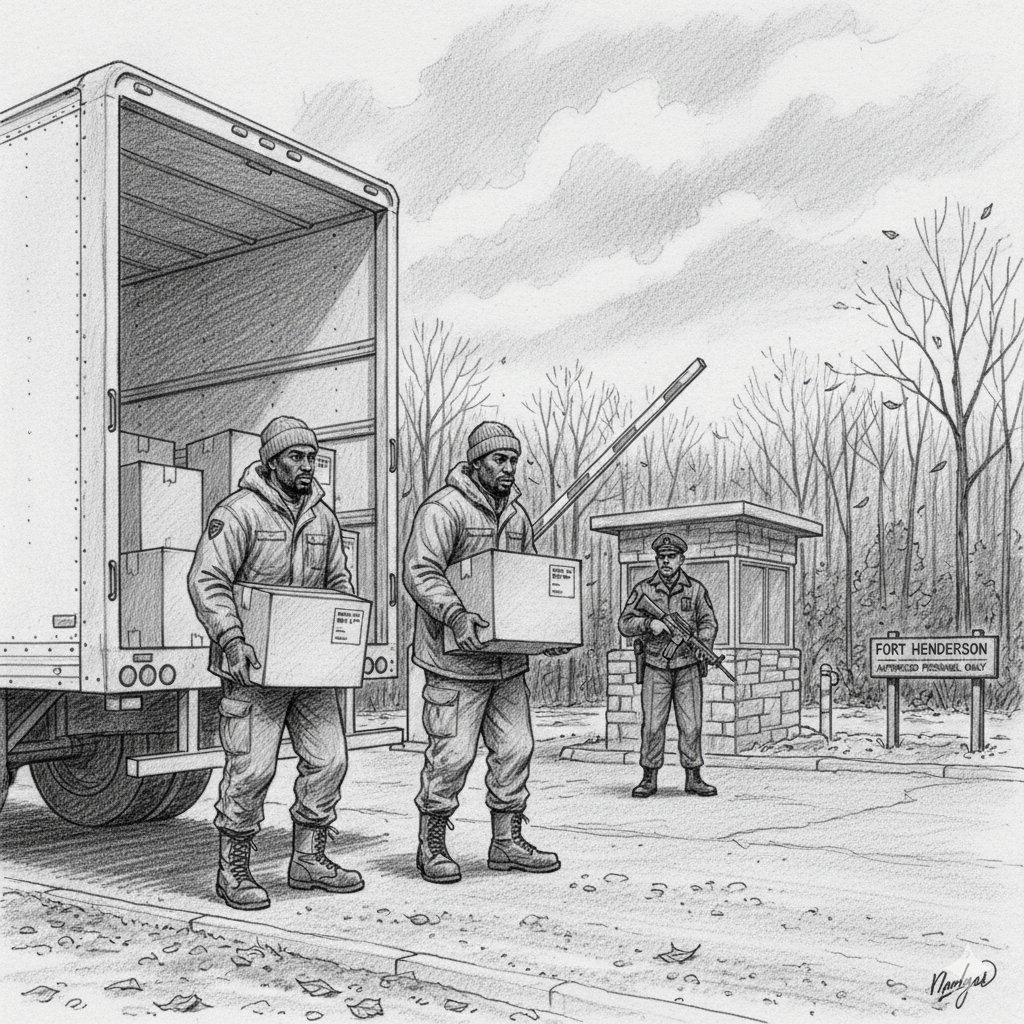
M________ is a devout Muslim from Ghana, West Africa. However, in 2018 his community discovered that he was bisexual. He was repeated assaulted by his neighbors, and was beaten so much that he still has missing teeth and other injuries. He fled to the US and was granted asylum. He had work authorization, always paid his taxes and has had no criminal record. He was working for Walgreens in Manchester, CT, but would pick up extra jobs when friends needed help.
He had a friend who was a truck driver who delivered computers. His friend asked M to help him with an emergency delivery of computers to a military facility in upstate NY. On November 14th he helped his friend load the truck at 3AM, and they drove 5 hours to upstate NY. They arrived at the military facility at 8AM. When they were going through the checkpoint, he provided his driver’s license as ID. They came back and started asking him for his social security number, etc. They then detained him and took him to the BC jail. They did not detain his friend because he has citizenship.
M______ says, “I wasn’t committing a crime. I was just going to work.” His friend feels guilty about what happened, and has been helping with things outside. M_______ already has a lawyer and is filing for an appeal because he was already granted asylum. He says most people in the jail are self-deporting because they do not have lawyers. He reiterates that he has a reasonable fear of returning to Ghana because he will be persecuted because of his lifestyle.
M believes everything happens for a reason, and that there is some reason why God put him in the BC Jail ICE detention center. He prays a lot. He believes that God will help him. He said that he has access to a bilingual Quran at the jail and that it works for him. He says he only eats cereal because he does not trust that the food is actually Halal.
The last time a volunteer spoke with M___, he said that he knew that he had an upcoming court date, but nobody at the facility could tell him when it would be. He did not know his A-number because the documents showing his A-number had been taken and stored by ICE when he was detained. His lawyer is non-reponsive.
R___, Sri Lanka. From Buffalo, NY.
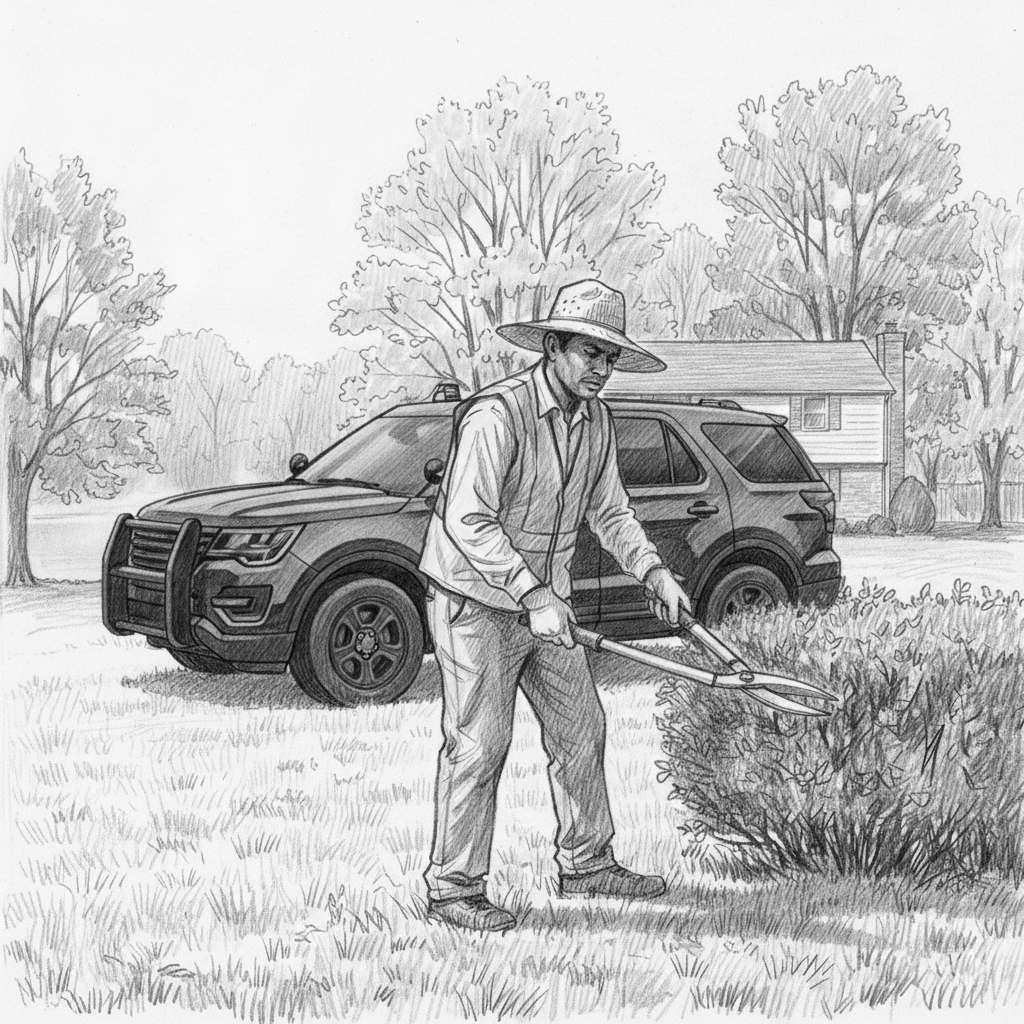
Ravirajh Sivanantharsha
R________ came to the USA from Sri Lanka in 2019 to escape the military dictatorship. He applied for asylum in 2020 but was denied in 2021 because some necessary paperwork did not arrive from Sri Lanka in time. He filed an appeal and received work authorization.
He was working as a landscaper in Buffalo when he was picked up by ICE on August 12th. He was in Batavia for 3 weeks and then came to the BC jail. He had a court date but there was not translator for his native language, Tamil. He filed for an appeal and has been waiting almost 6 months in the BC jail.
He cannot receive any direct phone calls from Sri Lanka. He has a friend who speaks Tamil who calls them from Buffalo and then he calls and relays the information to R_______. He has had no visitors and would like to practice English or even better, have a visitor who speaks Tamil.
R______ believes that if he returns to Sri Lanka he will be put in jail. He does not know the future so he does not make any plans. He loves America because of all of the rules that keep people safe. He loves Buffalo, including the chicken wings and the Buffalo sauce. He is Hindu and prays daily on his own.
Interviewed Friday, 1/23 by Christina Zawerucha. R__ is beginner English and would benefit from having a Tamil Translator for visits.
This person is in urgent need of a lawyer. If you are licensed to practice law in NYS, and are willing to take on this case, please contact us at humansofice@proton.me. If you are new to immigration law, we have experienced immigration lawyers prepared to mentor you
 Humans of ICE