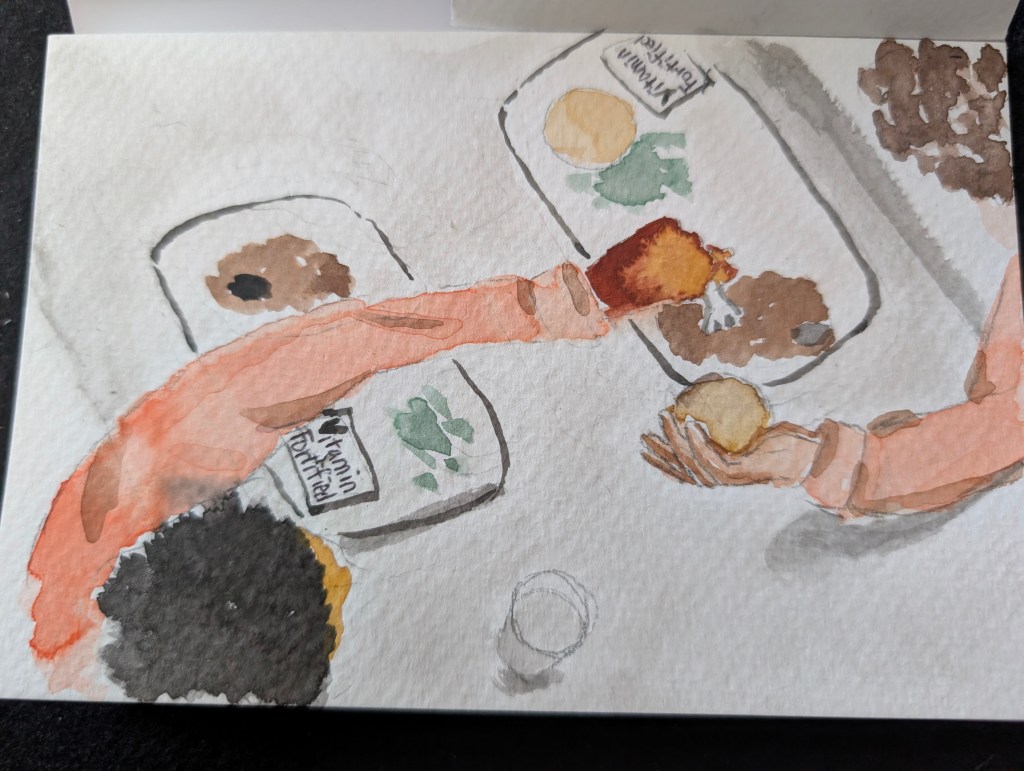
April 1-April 30, 2026 Call for Artists: Support Immigrant Detainees- Humans of ICE Community Story Telling and Advocacy Projec
Humans of ICE is a community storytelling project dedicated to supporting immigrants detained in the Broome County jail. Each week, volunteers organized by Concerned Residents of Greater Binghamton will visit the jail to meet with ICE detainees, listen to their stories, and learn about their needs and goals. Our mission is to connect these individuals and their families with the resources they need, while also sharing their experiences (with their permission) with the wider community to foster understanding and guide advocacy efforts.
We are putting a call out to artists to illustrate the narratives shared by the detainees, who have granted us permission to share their stories on social media. Jail visitors are not allowed to bring a paper or pencil into the visitation room, nor are we able to photograph or bring in any electronic devices, so we are asking illustrators to read the narratives and present their best illustration/image to portray this person’s story. We would like to prioritize artists of BIPOC and immigrant backgrounds when possible.
This is the starting point for a longer-working relationship with a group of artists interested in arts in activism. We are hoping to pilot this project for 6 weeks, with a goal of releasing 1-2 illustrated narratives each week. We plan to compensate artists $50 for each selected sketch/illustration. We are trying to cultivate a collective of artists to continue illustrating these narratives for the foreseeable future. We would like to credit each artist on social media when the narratives are released.
Learn more at humansofice.org
Directions: Please choose one of the following ICE detainee narratives and create an illustration communicating their story, with the purpose of being shared over social media. This is an ongoing project with rolling deadlines. Please upload your illustration to this Humans of ICE Art Submission Form by 11:59 PM on Friday, May 1st, 2026
| K is originally from Brazil and speaks Portuguese, Spanish and some English. In December 2025 he was leaving his carpenter job in the Greater Binghamton area & one of his coworker friends in his car realized there was a cop car following their truck. To be sure, K tried to change up his route and him & his coworkers confirmed they were being followed. The cop car flagged them to stop and they complied and pulled over. The cop asked for information and from there labeled K and his coworkers as illegal aliens. K and his coworkers were all Brazilian and K told me there were 3 other coworkers in his car that all got reported to ICE and then arrested. The 4 of them resided at the Broome county correctional facility. Recently, 2 out of the 4 were taken to a different facility according to K’s knowledge. K does not know where his other 2 coworkers were truly taken to. The coworker still in this facility is luckily his cell mate, but they know they can be removed from the facility at any moment. K spends his time reading his bible, occasionally receivifng 30 minute calls from his girlfriend and his 4 year old daughter, Y. His girlfriend and him have told his daughter that he is on a work trip, until she’s oldenough to know more. During my visit, he spent time to tell me about his family. Y, has long curly hair and is about 3ft tall. He has his daughter tattooed on his right forearm as a reminder of his hope. His girlfriend calls when she can and sends him virtual money so phone calls can be made to her. This is his only support systemin the United States. He has been in the US for about 7-8 years and came to the US for an opportunity for a better life and to make more money to support himself than he had back home. |
| R________ came to the USA from Sri Lanka in 2019 to escape the military dictatorship. He applied for asylum in 2020 but was denied in 2021 because some necessary paperwork did not arrive from Sri Lanka in time. He filed an appeal and received work authorization. He was working as a landscaper in Buffalo when he was picked up by ICE on August 12th. He was in Batavia for 3 weeks and then came to the BC jail. He had a court date but there was not translator for his native language, Tamil. He filed for an appeal and has been waiting almost 6 months in the BC jail. He cannot receive any direct phone calls from Sri Lanka. He has a friend who speaks Tamil who calls them from Buffalo and then he calls and relays the information to R_______. He has had no visitors and would like to practice English or even better, have a visitor who speaks Tamil. R______ believes that if he returns to Sri Lanka he will be put in jail. He does not know the future so he does not make any plans. He loves America because of all of the rules that keep people safe. He loves Buffalo, including the chicken wings and the Buffalo sauce. He is Hindu and prays daily on his own. |
Our Team will be using the following criteria to evaluate art: Humans of ICE Art Selection Criteria
Please let us know if you have any questions by emailing art@humansofice.org
Priority & Ethics Checklist
Beyond the numerical score, use these “Yes/No” filters to ensure the project stays true to its roots:
| Lived Experience: Does the artist identify as BIPOC or have an immigrant background? | Yes | No |
| Consent & Safety: Does the art respect the anonymity of the detainee if requested? (e.g., avoiding identifiable facial features if the detainee is at risk). | Yes | No |
| Tone Alignment: Does the style match the gravity of the story? (e.g., avoiding overly “cartoony” styles for very traumatic narratives). | Yes | No |
Guidelines for Reviewers: When looking at the art, keep these three principles in mind:
- The “Witness” Factor: Since visitors can’t bring in cameras or pens, the artist is acting as a “secondary witness.” Look for art that feels like it is listening to the story, not just decorating it.
- Avoiding Stereotypes: Be wary of art that relies on cliches (e.g., just showing bars or handcuffs). Prioritize art that shows the person, their dreams, or their specific cultural heritage.
Accessibility: Since these are for social media, the most effective pieces are often those with a strong focal point that remains clear even on a small phone screen.
 Humans of ICE